


Every week, talking to industrial automation and manufacturing companies, one thing keeps coming up: the opportunities are always there, but whether a business can seize them depends on how quickly it actually knows its own real capacity.
Drawing on the experience we’ve built up in the American Midwest, we had the pleasure of collaborating with Jamie Mitchel on a post about how companies face these challenges and how AI-driven solutions are making a real difference in day-to-day operations. His perspective amplified a fundamental conversation: resource planning isn’t just a technical topic — it’s a genuine strategic competitive advantage.
What did Jamie write?
Why capacity management (often) hasn’t changed in years
Machines have modernized thanks to Industry 4.0 investments, and we collect enormous amounts of data from PLCs and connected systems — but managing the resources that optimize production has stayed essentially the same: highly manual.
Many companies don’t have a clear view of:
- who’s available,
- which skills are needed to cover future workloads,
- how efficiency varies between operators on the line,
- which machines can be assigned and under what constraints,
- what’s actually producible in the next days or weeks.
Companies often still run everything through Excel and manual processes, leaning on the knowledge of a handful of experts. That works while things are simple — but as soon as line complexity, skill mixes, or order volume grows, it stops scaling.
The downsides of missing dedicated software include:
- load imbalances that are hard to prevent,
- safety and compliance risks,
- operator dissatisfaction.
It’s no coincidence that the Wisconsin Manufacturing Report 2025 identifies workforce management and retention as the top challenge for Midwest manufacturers.
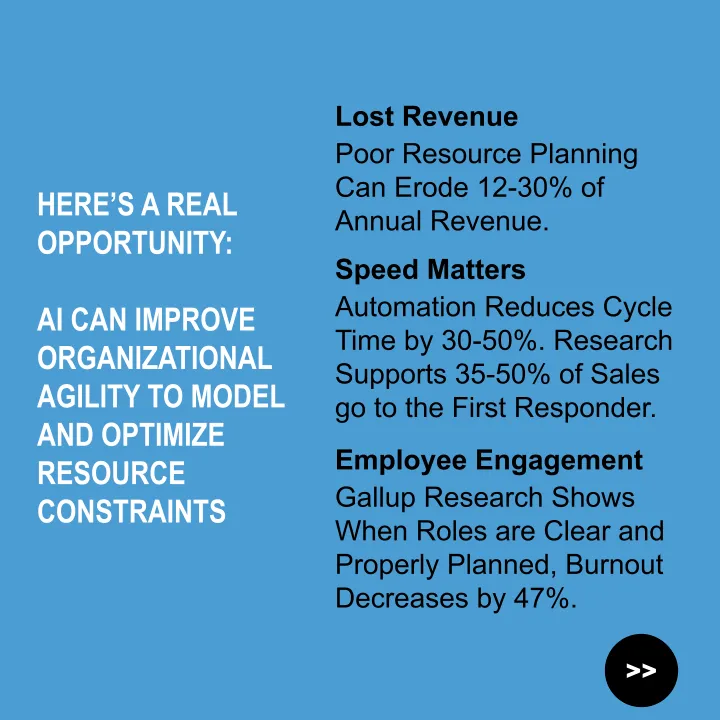
The numbers back it up: according to IDC 2025, poor resource planning can erode 12% to 30% of annual revenue — a real silent profit killer, as Jamie puts it. Meanwhile, in competitive markets the supplier that responds first wins 35% to 50% of opportunities.
Automation and generative-AI applications are steering this problem onto a workable path — one where the software doesn’t need to be adapted to the company; instead it adapts to the company’s reality, with all its specific constraints, goals, and the characteristics of its resources and production processes.
Flexible constraints and generative models vs. the off-the-shelf SaaS model
Traditional off-the-shelf schedulers often fail at modeling the constraints of human-resource planning.
In a world where you need to:
- define your own planning constraints,
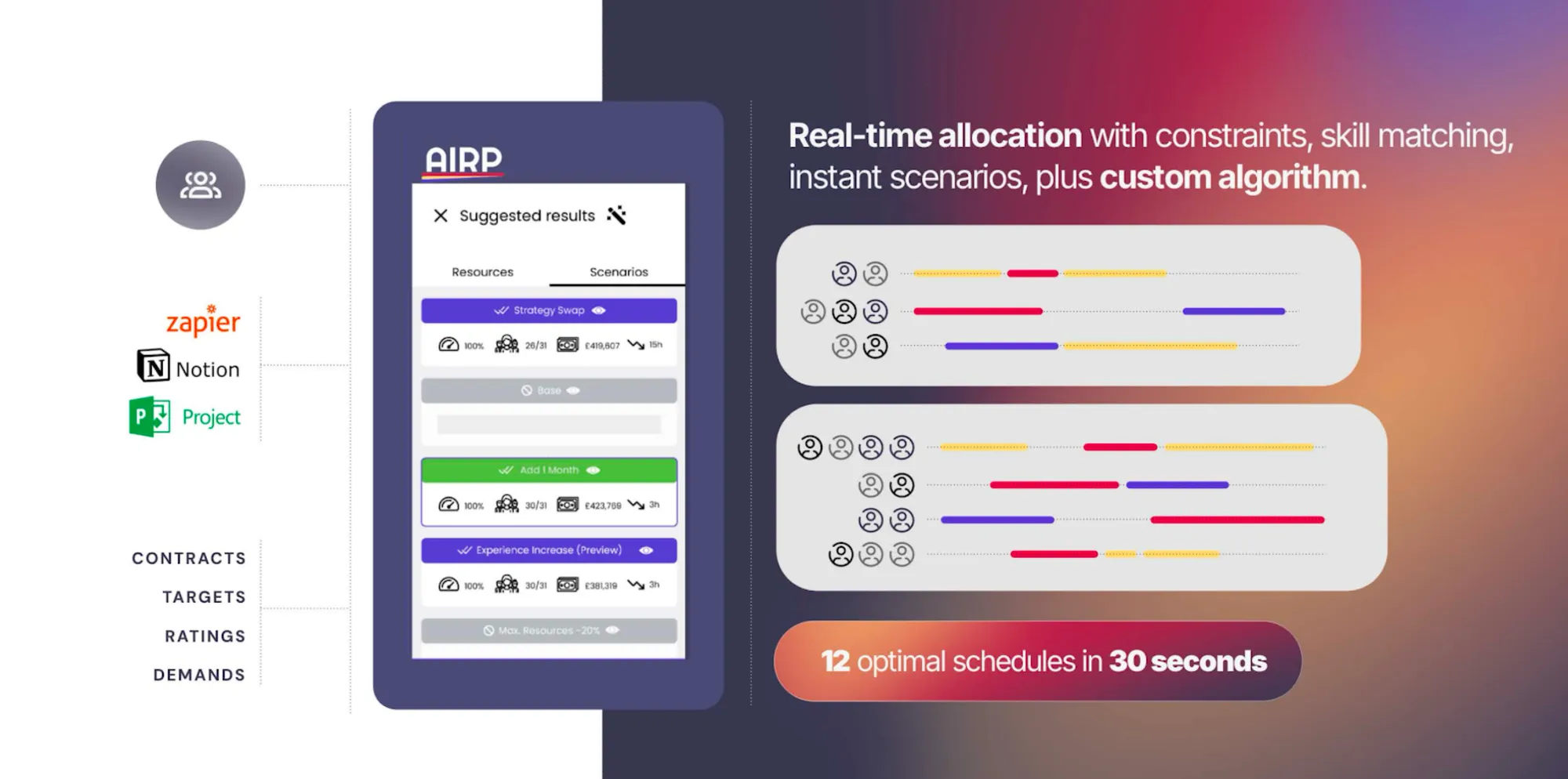
- model real-time scenarios,
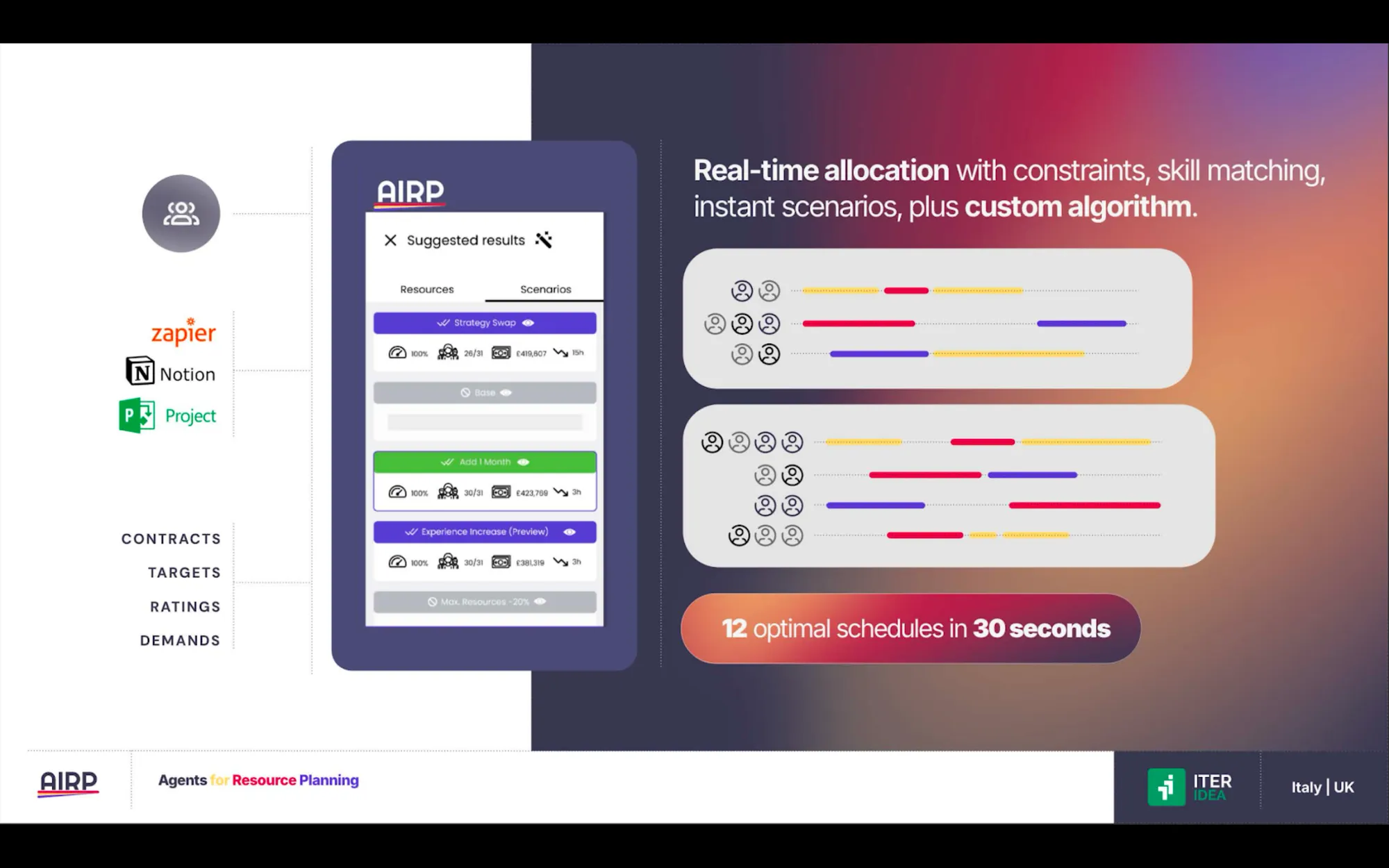
- generate optimal alternative plans in a few seconds,
- manage people, machines, and activities as one integrated system.
without overhauling the existing infrastructure. Nobody wants to spend €80,000 to replace IT or re-cable 50 production machines: you need a plug-in that works with your ERP and MES, reads the data already available, and doesn’t replace software or hardware.
Curious? Here are a few testimonials from digitalization projects we’ve run with AIRP (https://airesourceplanner.com/)
👉 Ghepi – Plant Manager (manufacturing)
“With AIRP we generate the optimal shift plan in 30 seconds instead of hours. Real-time planning lets us react instantly to production issues without losing efficiency.”
👉 Scottish Government – Jennifer Kinnaird (public administration)
“ITER IDEA delivered a solution that produces what we need today, with an eye on the future.”
👉 LEANTECH – Fernando Luzzara (manufacturing and engineering)
“We started the AIRP onboarding journey. Today AIRP is a strategic tool for coordinating our activities, keeping focus on departmental delivery timelines and supporting project meetings. Integration with the other software already in the company was handled smoothly.”
👉 Baggiovara Hospital – William Boni (ER Staff Coordinator, healthcare)
“AIRP ensures full coverage across all our areas, with particular attention to the specific skills required… Automatic management and scheduling of the various shifts… has eliminated a good part of the organizational pain points, improving the quality of work for every individual professional.”